
Walls That Stop Airflow Without Trapping Moisture
Open Cell Polyurethane Sprayfoam Insulation in Trenton for irregular cavities and assemblies where vapor permeability matters
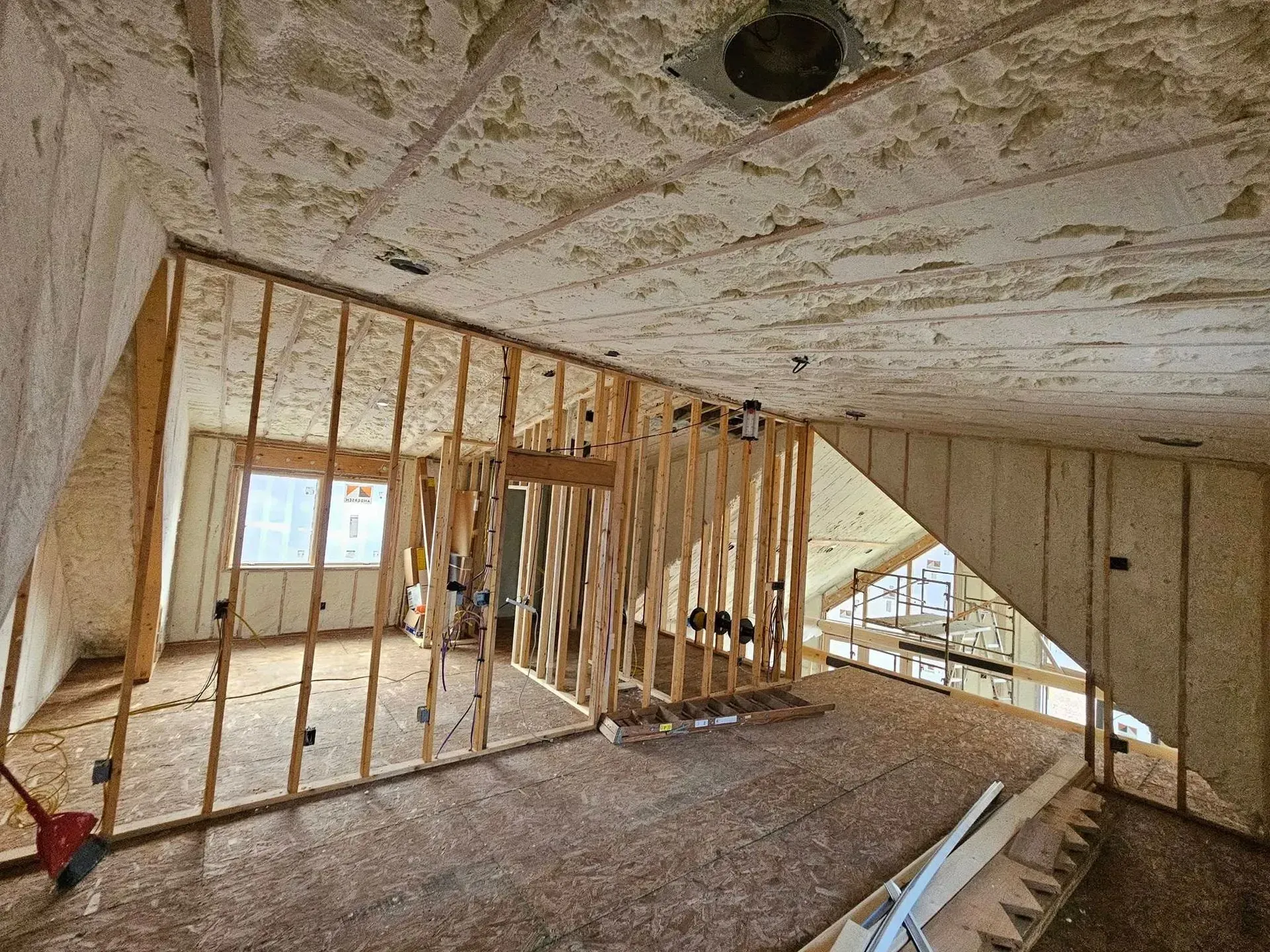
When wall cavities include wiring, plumbing, or framing irregularities that rigid insulation cannot navigate, open-cell spray foam fills those gaps and conforms to every surface it contacts. Evolution Sprayfoam, LLC applies this lower-density foam in assemblies where the goal is reducing air movement through the building envelope while allowing vapor to move through the material rather than condensing inside the wall. Property owners in Trenton often choose open-cell foam for interior walls, vaulted ceilings, and above-grade applications where the assembly design accommodates its vapor permeability.
The application involves spraying a liquid polyurethane mixture that expands to roughly one hundred times its liquid volume, filling stud bays and joist cavities in a single pass. Because the cell structure remains partially open after curing, the material allows some vapor transmission, which can prevent moisture from being trapped in certain wall designs where seasonal temperature swings create condensation risk.
Arrange a project consultation to compare open-cell and closed-cell characteristics based on your wall assembly and climate exposure in Trenton, Kansas City, and surrounding areas.
What Proper Open-Cell Application Requires
Proper application begins with evaluating the wall or ceiling assembly to confirm that open-cell foam suits the moisture profile and insulation target. The installer adjusts spray equipment to achieve the correct density and expansion ratio, because under-expanded foam does not seal properly and over-expanded foam can distort framing members.
Once the foam cures, you stop feeling drafts along baseboards and ceiling edges, and temperature variation between rooms decreases because conditioned air no longer leaks through framing gaps. The material remains flexible enough to move with seasonal wood expansion without cracking or pulling away from studs, and it does not settle over time the way loose-fill insulation does.
Open-cell foam does not provide the same moisture barrier or structural rigidity that closed-cell foam offers, so it works best in assemblies where a separate vapor retarder is installed or where the wall design allows drying to one side. The choice between foam types depends on whether your project prioritizes maximum R-value per inch, air sealing with vapor permeability, or structural enhancement.
Answers to Frequent Service Questions
Customers evaluating open-cell spray foam typically want to know how it compares to other insulation types and when it makes sense for their specific building assembly.
What makes open-cell foam different from closed-cell foam?
Open-cell foam has a lower density, typically around 0.5 pounds per cubic foot, and allows some vapor transmission, while closed-cell foam is denser, provides higher R-value per inch, and acts as a vapor barrier.
How does open-cell foam handle moisture if it allows vapor to pass through?
The material itself does not absorb and hold water like fiberglass, and in wall assemblies designed to dry toward the interior, the vapor permeability allows moisture to escape rather than accumulating inside the cavity.
When is open-cell foam the better choice over closed-cell?
Open-cell works well in climate zones and assemblies where vapor control is managed through other layers, where budget per square foot matters, or where the lower density and sound-dampening characteristics suit the project goals.
What R-value does open-cell foam provide per inch of thickness?
Open-cell foam typically delivers around R-3.5 to R-3.7 per inch, so achieving higher total R-values requires more thickness compared to closed-cell foam, which often reaches R-6 to R-7 per inch.
How long does installation take for a typical wall or ceiling cavity?
Spray times vary with cavity depth and project size, but most residential wall assemblies can be sprayed and allowed to cure within a single day, with trimming and finish work following once the foam has fully expanded and set.
Evolution Sprayfoam, LLC compares open-cell and closed-cell options based on your building assembly, climate zone, and insulation objectives. Contact the team to review your project specifications and determine which foam type aligns with your wall design and performance requirements.